Unit 3: GNSS computational methods II - Precise positioning » 3e. Computation of GPS wavelengths
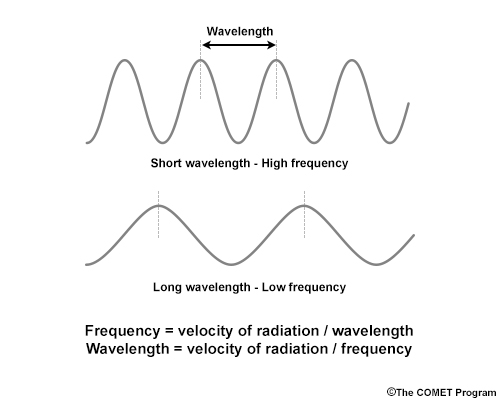
Frequency is the number of wave crests that pass the same point per second. It is expressed in cycles per seconds denoted as Hz (1 Hz = 1 cycle per second).
The frequency of GPS L1 signal is 1575.42 MHz (1575.42 x 106 Hz)
The frequency of GPS L2 signal is 1227.60 MHz (1227.60 x 106 Hz)
The wavelength of the two GPS signals can be computed using the following equation:
Wavelength = Speed of light ÷ Frequency of signal
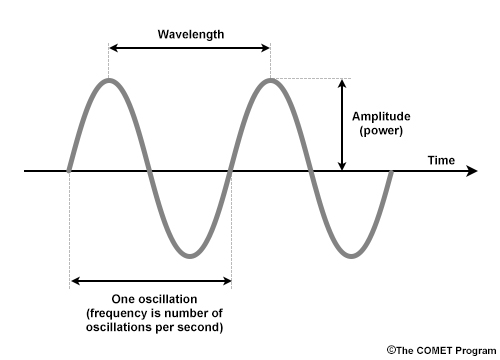
L1 Wavelength = 299,792,458 m/s ÷ 1575.42 x 106 s-1≅ 0.190 m ≅ 19.0 cm
L2 Wavelength = 299,792,458 m/s ÷ 1227.60 x 106 s-1≅ 0.244 m ≅ 24.4 cm
NOTE: L2 has a lower frequency than L1 so its wavelength is longer
To use wavelength of the L1 band as our tape measure, we need to be able to count how many cycles lie between us and the satellite.
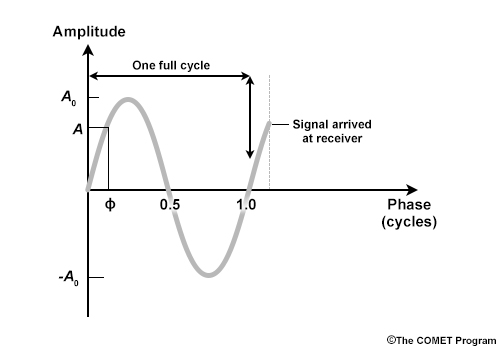
Figure shows a sine wave, representative of a GPS carrier signal. Although a cycle can start anywhere along the path of the wave, a full cycle is shown in the figure as spanning from the origin to the point (1,0) along the x-axis.
A full cycle is a complete sinusoidal curve, illustrated as the path from the origin to the point 1.0 along the x-axis. Counting wavelengths is essentially counting the number of cycles, and this is an integer count (1, 2, 3,... n).
Question
Assume the satellite is 20,166,318.727 meters away from the GPS antenna. How many wavelengths of the L1 signal would make up this distance?
20,135,196.834 m ÷ 0.19 m/wavelength = 105,974,720.179 wavelengths
If we could count just the instantaneous number of cycles at this one epoch, we would have counted 105,974,720 wavelengths - the integer portion of the solution.
Clearly, we’d be missing a fraction of the next cycle (shown as the extended part of the curve in the figure above). In the example, we’d be off by 0.179 cycles. At 0.19 m/wavelength, this error would be:
0.179 m x 0.19 cm = 0.034 m = 3.4 cm.
So we’d be off by several centimeters.